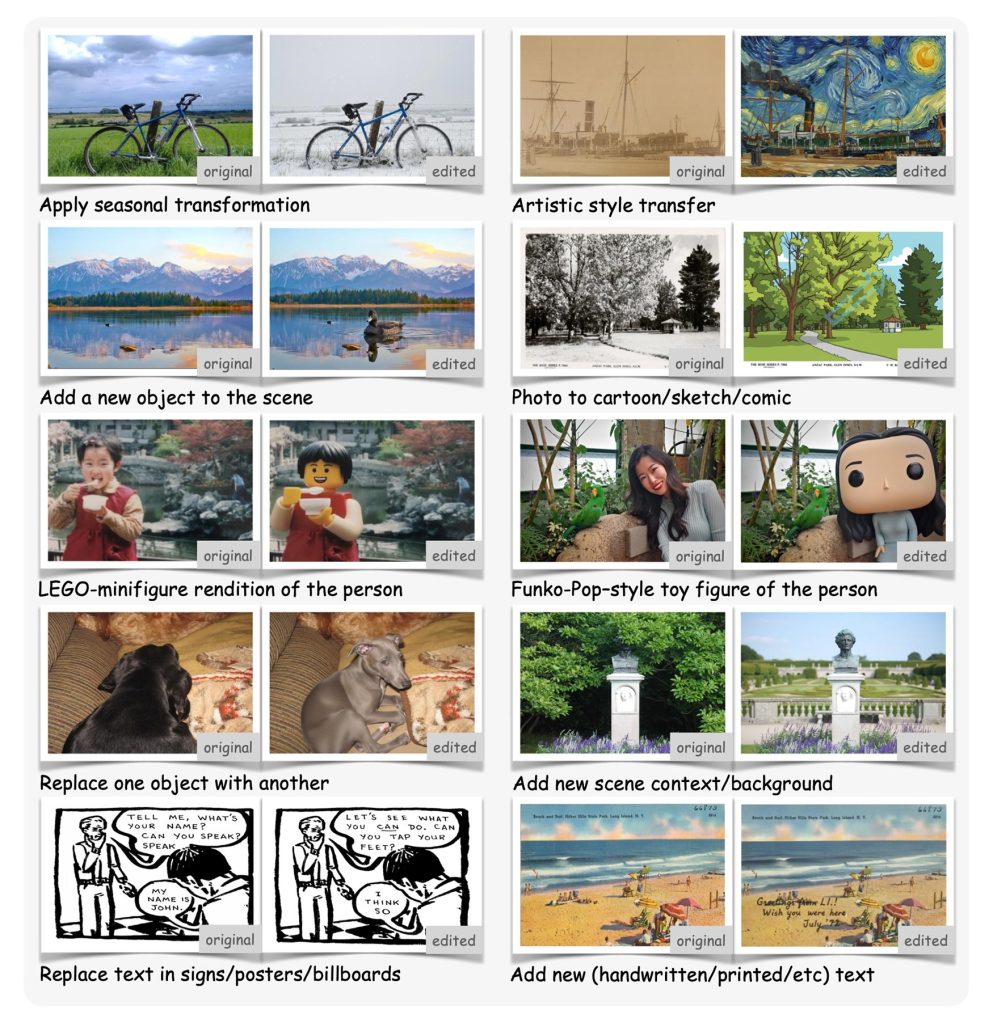
1. What is the Dataset?
- Apple has released a dataset called Pico‑Banana‑400K, containing approximately 400,000 curated image pairs (original photo + edited photo) designed for text-guided image-editing tasks. (Apple Machine Learning Research)
- The dataset is organized around a taxonomy of 35 edit types, spanning from basic photo swaps (colour/lighting adjustments) to more creative transformations (changing people into stylised characters, e.g., LEGO-style or cartoon-style). (MacRumors)
- It is divided into multiple subsets:
- ~258,000 “single-edit” examples. (MacRumors)
- ~56,000 “preference pairs” (successful vs unsuccessful edits) for alignment/quality modelling. (Apple Machine Learning Research)
- ~72,000 multi-turn sequences (i.e., progressive edits: an image is edited, then further edited) to support modelling of multi-step workflows. (Apple Machine Learning Research)
- The underlying images originate from “real photographs” (from the OpenImages collection), not purely synthetic generation, which is significant. (Apple Machine Learning Research)
- The dataset is open for non-commercial research use (i.e., non-commercial license) — meaning it’s publicly available to the research community, though its usage is limited for commercial exploitation. (Gadgets 360)

2. Why Apple Did This — The Motivation
From Apple’s published research:
- They note that despite the impressive capabilities of models such as Nano‑Banana (Google’s image editing model) and Gemini 2.5 Pro (Google’s multimodal large model), progress in image editing has been constrained by a lack of large-scale, high-quality, real-image datasets tailored for instruction-based editing tasks. (Apple Machine Learning Research)
- Many existing datasets rely heavily on synthetic images, simplified edits, or lack the diversity of real-world photography and editing complexities. Apple’s aim is to “bridge the gap” between research data and realistic editing demands. (AppleInsider)
- By providing a robust dataset with multi-turn edits and preference pairs, Apple is enabling deeper research into how editing workflows, instruction clarity, model alignment (what the user intended vs what the model did) and iterative editing should be handled. (Apple Machine Learning Research)
In short: Apple wants better data = better models = improved consumer and research outcomes for image editing.
3. Key Design & Technical Features
Let’s break down the elements with precision:
3.1 Taxonomy of Edits
- 35 distinct edit types: from global colour/lighting changes, to object removal/relocation, background modification, style transfers (e.g., turning into cartoon/LEGO/film style). (MacRumors)
- This taxonomy ensures coverage of both “easy” edits (global changes) and “harder” edits (spatial relocations, text replacements, semantic transformations).
3.2 Quality & Curation
- Apple used the Nano-Banana model to generate edits from real photographs, then leveraged Gemini 2.5 Pro (or equivalent) to automatically evaluate the edits for instruction compliance (did it match what the prompt said?), technical quality (artefacts, realism), and content preservation (did you keep what was supposed to be kept?). (AppleInsider)
- Only high-quality edits passing these criteria are included — this is important, because many earlier datasets include noisy, low-quality or mis-aligned edits.
- Inclusion of “preference pairs” allows research into reward modelling/alignment: not only what good edits look like, but what worse edits (or failure cases) look like, which helps model training and evaluation. (Apple Machine Learning Research)
3.3 Multi-Turn & Instruction Flexibility
- The multi-turn subset (~72K) models editing as a workflow (for example: prompt “make background blue”, then prompt “add flying bird in sky”, then prompt “apply cartoon style”), enabling research into chained editing, planning and context retention. (Apple Machine Learning Research)
- The preference subset (~56K) supports alignment research: which of two edits is better, given a prompt/instruction.
- Long vs short instruction variants: the dataset includes longer, training-style prompts and shorter natural prompts to mimic real user instructions. This allows research into instruction rewriting, summarisation, and robustness. (Apple Machine Learning Research)
4. What the Data Reveals: Strengths & Weaknesses
Interestingly — the research paper doesn’t just provide the dataset; it also documents which edit types AI models currently perform well on, and where they struggle.
- Example: Global style changes (e.g., colour, lighting) show ~93% success in Apple’s benchmarking. (MacRumors)
- In contrast, precise spatial edits (object relocation) or text editing (editing signage/text in a photo) perform below ~60% success. (MacRumors)
This is crucial: the dataset doesn’t just supply more data — it surfaces what remains difficult for current models, which helps focus research.
5. Implications for AI, Research & Content Creation
Given your interest in content, media, technology and research, here are the key implications:
5.1 For AI and Model Development
- This dataset becomes a benchmark: researchers will train and evaluate next-gen image-editing models against it, meaning we may see leaps in quality, realism and instruction fidelity.
- The presence of multi-turn edit sequences will push the field toward more interactive, workflow-based editing (not just one-prompt, one-edit).
- The preference pairs aid alignment research: making sure the model’s “good edit” aligns with human preferences, which is crucial for user-facing tools.
- Because real photographs (with real complexity) are used, the datasets close the “training vs real use” gap — harder to “hack” with synthetic only data.
5.2 For Content Creators / Image Editors / Bloggers
- As models improve, you will likely see more advanced image-editing features in tools (mobile, desktop) with better fidelity to your prompt (for example: “Make this photo look like Renaissance painting + daylight + removed background subject”).
- For your web-store, tech-blog and YouTube thumbnails: anticipating more sophisticated AI editing tools means you might adapt workflows (e.g., dynamic prompt + image pair editing) or even train your own internal tools using open datasets like this.
- The dataset helps inform what “good image editing AI” will look like — you can evaluate whether tools you’re using (or teaching others to use) meet the standards.
- For your audience (for example gadget lovers, tech enthusiasts) the existence of such a dataset is a talking point: you could produce a blog or video comparing old vs new editing tool capabilities, referencing the dataset.
5.3 For Media, Communication & Research
- From a media/communication studies lens: this dataset signals a shift in how images are edited — not just manual edits by humans, but AI-driven edits via natural language instructions. The “interface” of image editing is evolving.
- The “instruction-driven editing” paradigm may change how users conceptualise photography: you just describe what you want and the model edits. That may impact expectations of what is “authentic” or “manipulated”.
- For your research interest: dataset releases like this are valuable artefacts. You might analyse how the taxonomy (35 edit types) mirrors user intent, how workflows evolve, or how media consumption changes when edited images proliferate.
6. Limitations & Things to Watch
- License: The dataset is available only for non-commercial research use. That means commercial tools or businesses can’t (yet) freely exploit it in product releases unless they get additional licensing. (Gadgets 360)
- The dataset is still a “reference/benchmark” rather than a full deployment product. Just because the data exists doesn’t mean all editing models will immediately improve in real-world tools.
- As Apple acknowledges, some edit types remain challenging (object relocation, text edits) — so even with this dataset, we’re not at “perfect” AI editing.
- Data biases: even though real photographs are used, we should consider diversity of image subjects, cultures, lighting, geographical contexts — research may reveal gaps.
- Privacy/ethical issues: AI-edited images might blur lines of authenticity, manipulate visuals more easily, raising questions about manipulation, misleading visuals, trust in media.
7. Summary & How This Fits Into the Bigger Picture
To summarise: Apple’s Pico-Banana-400K dataset is a significant step forward in the field of text-guided image editing AI. It offers a large, real-photo based, richly annotated set of image edits (single & multi-turn), preference pairs, a taxonomy of editing types, and is openly available (for non-commercial research) to catalyse further advancements. For creators, researchers, and media analysts, this signals accelerated change in how images are edited, consumed, and produced.
Given your background (content research, media analysis, tech interest) this dataset is notable because it:
- Bridges the “research data → practical tool” gap in image editing.
- Enables new workflows (edit chains, multi-turn editing) which may change how content is produced.
- Raises questions of authenticity, manipulation, media representation which align with your research interest in how content reflects/affects society.